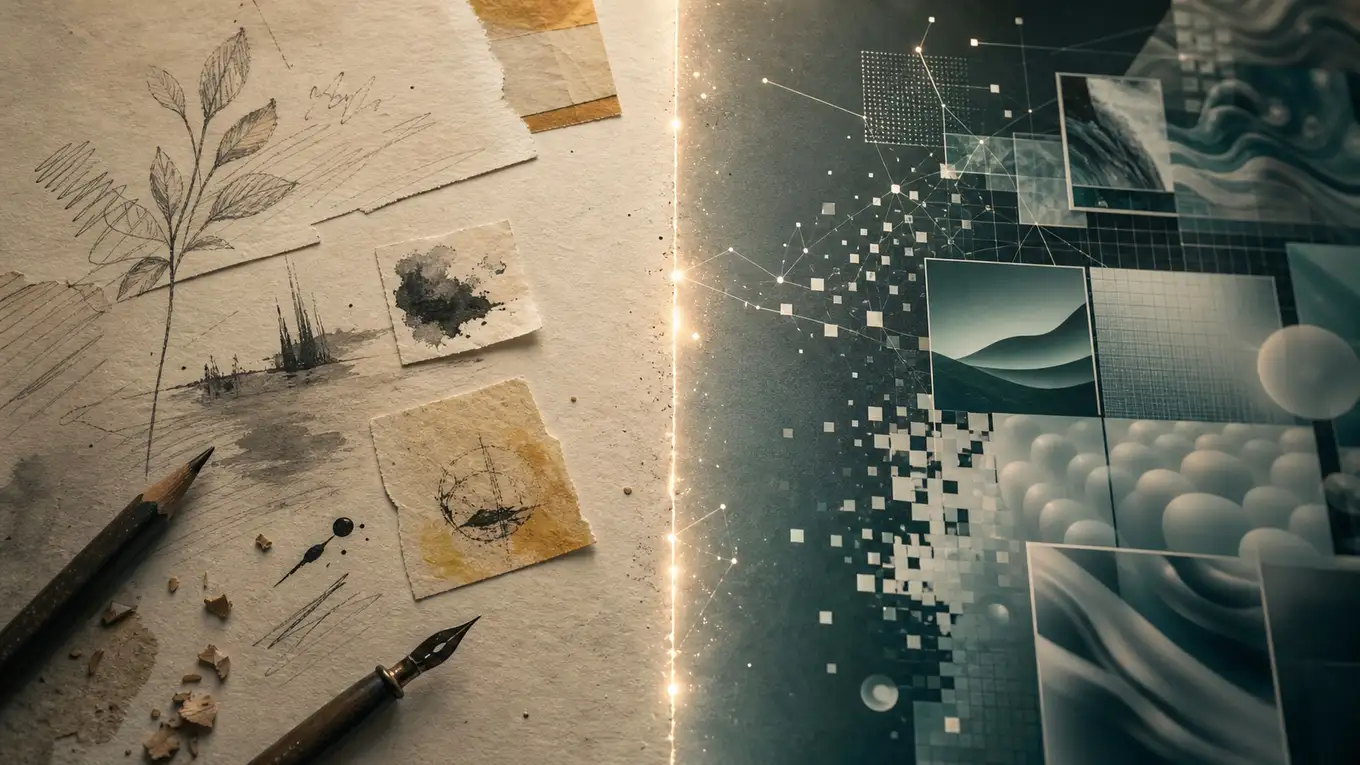
Where is the line between acceptable AI usage in content creation? Does some AI generated content contaminate the whole piece into slop, or is there more nuance to be found in how we create content with AI?
I’ve noticed something interesting about the reaction of AI in society. Some people have embraced the technology so completely they have no problem with letting AI write for them. Then there are those who reject AI completely, they don’t see the benefits and never use it. They see all variety of AI-assisted and AI-generated content as one thing: slop that isn’t worth their time.
Recently a short story won a Commonwealth short story prize.1 Was it written by AI, or AI assisted writing, or did the author adopt some common “AI tells” unknowingly? Which came first, the writing devices overused by AI or the writers who used them? As the models become better every couple of months AI generated content becomes harder to recognise as such. Those who don’t use it frequently may not spot what others think is obvious.
Kranzberg’s First Law reads as follows: Technology is neither good nor bad; nor is it neutral.2 Technology works in the context of society, what is embraced as empowering for some it will be seen as a threat for others. I think for AI this is cutting across different groups within society and for those that AI empowers others see that as a threat. The divide between those who have embraced it completely and those who see a threat is growing as the models improve at a fast pace.
Another consideration is that just because a piece of writing is detected as “100% AI writing”, does that mean it’s not worth reading? If a person has put their thoughts, their seed ideas, into that piece of generated content (and assuming they read it and were happy to publish it) then their idea is out in the world in some form. Is this kind of content “written” by the person since they had the ideas? It might be poor form but it’s still come from the intent of a person.
Given good inputs and direction the AI models today produce good content but after a while it starts to look very similar to other generated content. There are the well known AI writing tells, such as the em dash – yet many writers who love a dash still use them (I prefer the en dash). There are other problems particularly how it can heavily centre on certain devices such as the “it’s not X, it’s not Y, it’s Z” too much so that there is little variability in the prose. Line by line it may not be too bad but the whole construction can feel unnatural.
I reflect on this since I have recently become interested in improving my writing and developing my skills, yet I find AI useful in this process. I ask what are my limits in what I allow AI to do for me vs what I do myself? I use it to research, brainstorm ideas, and review my writing. I’m comfortable with AI generating images that go along with my writing but not to write for me. I think it’s worth reflecting on what you would find as an acceptable or unacceptable application of AI usage.
From the beginning, the web has been built on user generated content from the first personal sites to blogs to social media. This content has always varied but having some control over the quality of information would be nice. What we call “slop” already existed before AI but now it’s faster and easier than ever to publish it. How long until we see a quality filter that can detect AI or human content so we can fine tune our feeds?
Heraclitus said “the name of the bow is life, but its work is death”3. The bow is a useful tool that can be a weapon but it can also be used for defence. We can point our AI bow toward the AI slop, shooting it out of our social media feeds but perhaps it is better to use AI in a way that does not create it in the first place?
Footnotes
-
“‘Obvious markers of AI’: doubts raised over winner of short story prize,” The Guardian, 19 May 2026. Read the article ↩
-
Melvin Kranzberg, “Technology and History: Kranzberg’s Laws.” PDF ↩
-
Heraclitus, Fragment 48: “the name of the bow is life, but its work is death.” ↩